Choosing a Game Region Based on Language Support, Event Times, and Community Activity
A game region is viable only when the team can support players’ languages, schedule events fairly, maintain a community, meet local rules, and deliver acceptable latency. These factors should be assessed together.
A 3-Step Framework for Developers in Selecting Game Regions
- Step 1 – Language Support Matching: Review store traffic, wishlists, demo use, sales, reviews, support tickets, and community requests by language. A country’s English Proficiency Index does not show whether likely players can understand tutorials, dialogue, payments, and safety information. Steam recommends using traffic, sales, and community feedback and warns developers not to confuse language with geography.
- Step 2 – Live-Ops Event Time Synchronization: Map activity by time zone before scheduling maintenance, resets, tournaments, or limited rewards. Hardcoded times do not directly corrupt saves, as the original claimed, but poor time handling can display the wrong deadline or close an event unexpectedly.
- Step 3 – Community Vitality Measurement: Compare DAU, MAU, retention, peak concurrent users, queue health, support demand, and official-channel activity. Social follower counts do not determine server capacity; latency, matchmaking, platform mix, and expected concurrent load also matter.
Analyzing Steam’s Language Map: Which Regions Demand Localization?
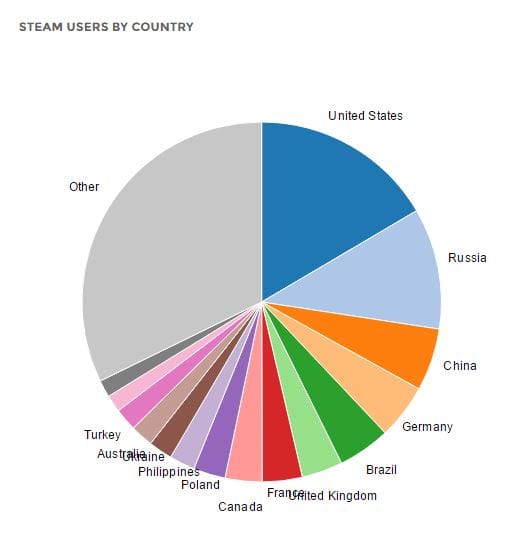
Valve’s Steam Hardware & Software Survey is optional, anonymous, and monthly. Its language table reflects interface languages reported by participants, not country population, revenue, or willingness to buy an English-only game.
Steam Language Market Share Data
The figures below come from the June 2026 survey and will change over time.
| Language | Market Share (%) |
|---|---|
| English | 38.18% |
| Simplified Chinese | 24.19% |
| Russian | 9.61% |
| Spanish – Spain | 4.59% |
| Portuguese – Brazil | 4.00% |
| German | 2.71% |
| Japanese | 2.64% |
| French | 2.26% |
| Korean | 1.48% |
| Thai | 0.88% |
The Rise of East Asian Languages
Simplified Chinese represents a large share of the survey, while Japanese and Korean also appear among the listed languages. English nevertheless remained ahead of Simplified Chinese in June 2026. Survey share can fluctuate and does not prove purchasing power.
Combine platform data with the game’s wishlists, purchases, demo completion, refunds, and community requests. The same language may be valuable for one title and a poor investment for another.
A Practical Localization Priority Rule
There is no recognized “ROLI Rule,” and the claims that 90% or 92% of consumers in named countries require native-language products could not be verified.
Priority Group: Prioritize languages already producing meaningful traffic, purchases, support questions, or creator interest. A story-heavy RPG may need full text and voice planning, while a simple multiplayer title may begin with UI, tutorials, store copy, and support.
Secondary Group: High English proficiency may reduce friction, but localized legal, payment, accessibility, and community text can still matter. Delay a language only when expected demand does not justify translation, testing, and continuing support.
Designing Event Times for Live-Service Games: Time-Zone Alignment vs. Cultural Festivals
A worldwide event can use one authoritative start and end timestamp while displaying the correct local time. Separate regional windows may be preferable when fairness, staffing, or cultural context requires them.
Operational Risks of Time-Zone Misalignment
Maintenance during peak hours can block matches or limited rewards. Short events may favor one time zone. Measure the effect through participation, support contacts, concurrency, and retention instead of applying an unsupported churn percentage.
Code-Level Time Handling Techniques
- Store authoritative timestamps in UTC and convert them with maintained IANA time-zone identifiers. The IANA database is updated when governments change UTC offsets, boundaries, or daylight-saving rules.
- Format dates, numbers, and 12- or 24-hour time with locale data instead of manually assembled strings. Unicode CLDR supplies conventions used by operating systems, browsers, and programming frameworks.
Synchronizing Live-Ops Schedules With Southeast Asian Holiday Cycles
Southeast Asian countries differ in language, calendars, payments, devices, and holidays. Build the calendar country by country.
Testing In-App Purchase Potential With First-Party Data
The claim that in-app purchases account for exactly 65% of Thailand’s gaming revenue lacked a current authoritative source. Evaluate payer conversion, revenue per paying user, refunds, local pricing, and payment success within the game.
Aligning Event Cycles with Local Cultural Holidays
- Indonesia: Ramadan, Independence Day, and Nyepi may affect schedules, but they are not interchangeable nationwide themes. Nyepi is especially associated with Bali. Local review is needed before using religious or cultural imagery.
- Thailand: Songkran is the traditional Thai New Year festival and has recognized cultural significance. A themed event should be developed with local review rather than reduced to generic water imagery.
- Operational Impact: Do not assume a holiday will increase spending. Compare participation, purchases, complaints, and regional sentiment with ordinary weeks.
Opportunities and Challenges in the Southeast Asian Region
The original $13 billion, $19 billion, 344 million-player, and $63.90 ARPU figures lacked one consistent authoritative dataset. Estimates differ by platform and revenue definition.
Market Potential: Use sources that define geography, platforms, revenue categories, currency, and measurement period, then compare them with the game’s genre, hardware needs, price, and payment access.
Player Base and Platform Mix: Separate mobile, PC, and console users, paying users, connectivity conditions, and hardware eligibility.
Regulatory Barriers to Navigate
Indonesia: The 2024 game-classification regulation requires publishers marketing games in Indonesia to register as a private-scope electronic system operator through OSS, complete self-classification, and display the result. It does not support the blanket claim that every publisher must automatically establish a local legal entity.
Vietnam: Decree 147/2024 establishes category-specific licensing, notification, age-classification, account-verification, and operating requirements. G1 online game licensing includes a requirement that the provider be an enterprise established under Vietnamese law. Publishers must identify the game category and distribution model rather than rely on one broad censorship statement.
UI Optimization Techniques for Regional Language Characteristics
Localization must be supported by the interface, fonts, and quality assurance. A fixed UI often causes clipping or poor line breaks.
Dynamic Container Design for Text Expansion
The claim that Indonesian and German text always expands by 20% to 35% is unreliable. Use flexible containers, wrapping, scalable menus, and pseudo-localization. Unity recommends pseudo-localization to expose limited space, hardcoded strings, unsupported characters, and RTL issues before real translations arrive.
Handling Stacked Diacritics and Complex Writing Systems
Supporting languages with complex writing systems requires careful testing to ensure text is displayed correctly across the entire interface. For Vietnamese, developers should use fonts that include all required glyphs and verify that headings, uppercase text, dialog boxes, and small UI labels render correctly without clipping stacked diacritics. Thai, as an abugida, requires language-aware text shaping and line-breaking because spaces typically separate phrases rather than individual words, making simple space-based wrapping unsuitable. For right-to-left (RTL) languages such as Arabic, interfaces must support bidirectional text rendering, proper reading order, and RTL-aware layouts, while also being tested with mixed content containing numbers, Latin words, or item codes to ensure compliance with the Unicode Bidirectional Algorithm.
Leveraging Specialized AI Translation Tech to Reduce Region Entry Costs
Machine translation can accelerate first drafts, repeated strings, and terminology checks. These tools should remain inside a controlled workflow rather than replace translators and build testing.
Pitfalls of Generic LLMs
A model may choose the wrong meaning for “tank,” alter placeholders, change character voice, use inconsistent item names, or create text that does not fit the interface. Legal, payment, safety, and age-rating text needs careful review.
Standardized AI Translation Pipeline
A professional game localization workflow should seamlessly connect source control, a Translation Management System (TMS), terminology management, contextual references, linguistic review, and build testing to ensure consistent translation quality. Glossary integration helps lock approved names for characters, abilities, currencies, interface buttons, and other recurring terms, while translation services may support glossaries and custom models but still depend on well-maintained terminology and regular quality evaluation. In addition, style guides should clearly define tone, formality, punctuation, pronoun usage, capitalization, and language-specific length constraints to maintain consistency across all localized content. Providing in-context UI screenshots further improves translation accuracy by giving translators information about the screen, speaker, user action, and character limits, although the localized text should always be verified through in-game build testing to ensure it fits correctly within the interface.
The Irreplaceable Role of Human-in-the-Loop
Native-language reviewers should verify meaning, cultural fit, terminology, voice, accessibility, and compliance-sensitive text. They should also play the localized build because a correct translation can still appear on the wrong screen or be cut off.
Select regions using evidence from the game: language demand, local-time activity, community health, latency, platform access, payment performance, and regulatory feasibility. Steam language data can inform planning but cannot predict revenue alone. The strongest expansion plan is the one the team can support consistently after launch.